
Why The Kid Who’s Always Going to the Bathroom Isn’t Necessarily Just Trying to Skip Class


So, you’re in class and Mattia’s hand shoots up. Again. He needs to go to the bathroom. Again…
If you’re anything like me, you might be tempted to ask whether his bladder is, in fact, a 70-year-old leather ball that’s been chewed by a bear, but wait one moment before judging Mattia too harshly. Not every hand that shoots up repeatedly and asks to go to the bathroom is a child trying to get time out of class… Let me explain.
When I was at school, it was common that teachers would refuse to let their students go to the bathroom during class, or there would be a hall pass system in play – where you had to have a written permission slip to pass through the halls unchallenged. Fortunately, in the past few decades things have changed significantly, and teachers are advised to let their students use the bathroom whenever they need to, with many schools abandoning hall pass systems and, in some cases, not even requiring permission to pop to the loo.
So why are we talking about using the bathroom today?
Well, because it part of a series of issues that regularly come up for many neurodivergent people and can lead to deep shame or embarrassment if handled incorrectly, as the neurodivergent nervous system doesn’t always report accurately on the state of the internal affairs of the body.
That’s not to say that neurodivergent kids don’t try to slip out of class to go and do something “more interesting” using the excuse of needing the loo. I was one of them, I just wanted to wander around the quiet halls while everyone was in their classrooms, feeling like a bit of a rebel and not wanting to tear my skin off from being forced to sit still and listen to the teacher talk about something I’d already understood from the introductory explanation.
But when it’s not about bouncing off of quiet walls, what is it about? And why can it have such a profound impact on the person’s psyche?
Let me share an embarrassing moment which highlights what I’m talking about. When I was around 7 or 8, I was a squirmy little thing, always wanting to move around and bounce off of the walls, daydreaming of running under the trees and wondering what it’d feel like to be a deer (I was obsessed with the film Bambi), and my teachers knew it.
Given this was around 30 years ago, I was just labelled as one of “those” kids and kept under strict observation, but one day, shortly after coming back from break, I needed to go to the bathroom. URGENTLY. My teacher, Mr Brown, told me that I’d have to wait until the end of the lesson and knowing how urgent it was, I loudly protested in a very unladylike way that I’d been ill for a few days and either he’d let me use the bathroom or I’d do it right there and that it’d be… nasty (redacted because we don’t need the whole description I gave in that moment).
The whole class stopped in their tracks. Mr Brown wasn’t a gambler, and let me go, but that moment of utter panic and public humiliation has been burnt into my memory in a way that even as a nearly 40-year-old woman I can still remember the way the class looked, what the weather was like (sunny) and the silence after my … description.
I hadn’t been ill, but the urgency was real. Why?
As an adult, this is a topic that I’ve researched quite a lot for my thesis, and then more in connection with my social media psychoeducational project on neurodiversity and staying fit, and the short answer is one word: interoception.
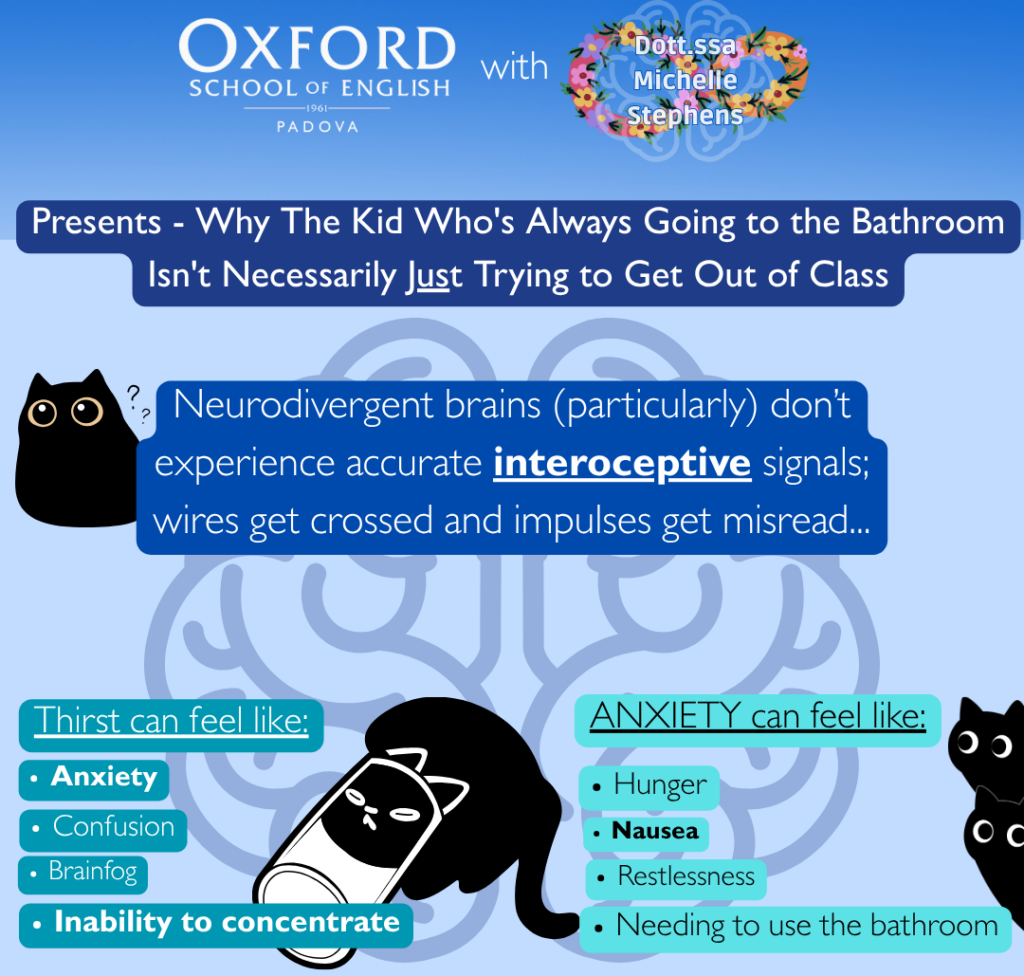
Interoception is the body’s internal flagging system – it tells you what needs to be done, where and how. Hunger? Interoceptive cue. Thirst? Interoceptive cue. Tiredness? You guessed it, interoception.
The thing is that, in neurodivergent brains, those signals can get badly mixed up. For example, as an adult, I know that when I feel nauseated, actually, I usually just need to use the bathroom. Or that when I’m unexpectedly hungry it’s because I’m anxious.
That day, the opposite had happened. My brain didn’t register the need to use the bathroom before it became a blaring foghorn of a warning, and when I heard it, it was past time to have gone. This still happens frequently, but now I occasionally exploit the phenomenon to get stuff done without taking bathroom breaks.
Helpful… right? Not so much. But what does all of this have to do with kids in classrooms? How does interoception affect our classes?
Most people think of sensations such as hunger, thirst, a full bladder or tiredness as obvious and unmistakable. Even though many people know that thirst can sometimes be mistaken for hunger, for many neurodivergent individuals these signals can be much harder to interpret accurately.
The brain might receive the message, but then it struggles to identify its source, causing the sensation to be experienced as something entirely different. These impulses don’t come with a clear label on them – a bit like a letter that’s got the correct address on it, but no name, so it’s not clear who it’s actually for in the household. A child who needs the toilet may feel anxious, nauseous or restless instead. Or they might appear distracted or irritable, when actually they’re thirsty or dehydrated. Some children may not notice bodily signals at all until they become completely overwhelming and 100% urgent.
The brain is great at streamlining and saving energy, so rather than remain undecided about the cause of the sensation, it attributes it – with all of the best intentions in the world – to the most likely reason. Pressure against your stomach? Well, in the past that’s been because you were about to vomit, and so your brain, being the good little worker it is, says “ah ok, I can’t quite place it but that’s good enough – we might be about to vomit, let’s sound the vomit alarms” and nausea comes out of the equation. Your brain hasn’t learnt well enough to associate that feeling with other causes – like gas in your digestive tract, the urgency to defecate, anxiety etc
If adult brains can’t quite get it “right”, now imagine being seven years old…
If adult brains can’t quite get it “right”, now imagine being seven years old and repeatedly being told that you’re making excuses, being dramatic, or trying to get out of work when you genuinely feel uncomfortable. You don’t know that what you’re experiencing is a difference in interoception, and you’re not going to be able to learn that when you’re quietly being denied your own, human experience. All you know is that your body feels wrong and it’s trying to assume the cause to help you find equilibrium again, but the adults don’t believe you, and you’re getting into trouble for trying to solve the problem.
Over time, many neurodivergent children learn not to trust their own bodily signals. They ignore thirst because they’re told they can’t possibly be thirsty again, or they sit through growing discomfort because they’re worried they won’t be believed. They’ll probably stop asking for help because asking has become embarrassing.
It’s ironic, but this can make the problem worse. A child who doesn’t recognise the early signs that they need the toilet may not realise until the situation becomes urgent. Someone who doesn’t recognise thirst may become dehydrated and struggle to concentrate and so their behaviour may well decline. And someone who mistakes anxiety for hunger may begin developing complicated relationships with food without ever understanding why. It’s the beginning of the cycle.
So what can we do to help our Neurodivergent students?
Responding with curiosity rather than suspicion gives children the opportunity to learn what their bodies are trying to tell them. Instead of teaching them that their internal experiences are wrong, we help them build the self-awareness that many neurodivergent adults spend years trying to develop later in life.
Encouraging body-aware programmes in class, or with parents, can also be a massive help – interoceptive awareness isn’t always intuitive but it can be taught through mindfulness practices.
So the next time a child asks to go to the bathroom for the third time that day, it may be worth pausing before assuming they’re trying to escape your lesson.
They might be. After all, I certainly did it often enough and was utterly unrepentant about it.
But, they might also be trying to solve a problem that they don’t yet have the words, awareness or confidence to explain, and if there’s one thing I’ve learned from a lifetime of confusing interoceptive signals, it’s that the body doesn’t stop sending messages simply because other people don’t understand them.
Details
Hi, my name is Michelle and I’m a neuropsychologist (LM51), educational coach and qualified teacher (PGCE) with nearly 20 years of experience in the field. I’m working with Oxford School of Padova to bring inclusion topics into the field of English teaching and education in general. This article is part of a series in which we’re exploring different neurological and neuropsychological concepts which aim to not only improve accessibility to education, but also give YOU – the parent or teacher – concrete ways in which you can achieve this with your students.
Did this help?
Follow us for more as we launch our new inclusion programme aimed at increasing accessibility to education for neurotypical and neurodivergent students alike!
For more information on the programmes, workshops and coaching we offer please contact inclusione@oxfordschool.com or 049 656180
References (and reading!)
American Psychiatric Association. (2022). Diagnostic and statistical manual of mental disorders (5th ed., text rev.; DSM–5–TR). American Psychiatric Publishing.
Barkley, R. A., & Fischer, M. (2019). The unique contribution of emotional impulsiveness to impairment in major life activities in hyperactive children as adults. Journal of the American Academy of Child & Adolescent Psychiatry, 49(5), 503–513. https://doi.org/10.1016/j.jaac.2010.01.019
Faraone, S. V., Banaschewski, T., Coghill, D., Zheng, Y., Biederman, J., Bellgrove, M. A., Newcorn, J. H., Gignac, M., Al Saud, N. M., Manor, I., Rohde, L. A., Yang, L., Cortese, S., Almagor, D., Stein, M. A., Albatti, T. H., Aljoudi, H. F., Alqahtani, M. M. J., Asherson, P., … Wang, Y. (2021). The world federation of ADHD international consensus statement: 208 evidence-based conclusions about the disorder. Neuroscience & Biobehavioral Reviews, 128, 789–818. https://doi.org/10.1016/j.neubiorev.2021.01.022
Kooij, J. J. S., Bijlenga, D., Salerno, L., Jaeschke, R., Bitter, I., Balázs, J., Thome, J., Dom, G., Kasper, S., Nunes Filipe, C., Stes, S., Mohr, P., Leppämäki, S., Casas, M., Bobes, J., Mccarthy, J. M., Richarte, V., Kjems Philipsen, A., Pehlivanidis, A., … Asherson, P. (2019). Updated European Consensus Statement on diagnosis and treatment of adult ADHD. European Psychiatry, 56, 14–34. https://doi.org/10.1016/j.eurpsy.2018.11.001
Nigg, J. T. (2013). Attention-deficit/hyperactivity disorder and adverse health outcomes. Clinical Psychology Review, 33(2), 215–228. https://doi.org/10.1016/j.cpr.2012.11.005
Ramsay, J. R., & Rostain, A. L. (2015). Adult ADHD: Research, diagnosis, and treatment. Routledge.
Russell, A. E., Ford, T., Williams, R., & Russell, G. (2016). The association between socioeconomic disadvantage and attention deficit/hyperactivity disorder (ADHD): A systematic review. Child Psychiatry & Human Development, 47(3), 440–458. https://doi.org/10.1007/s10578-015-0578-3
Young, S., Moss, D., Sedgwick, O., Fridman, M., & Hodgkins, P. (2015). A meta-analysis of the prevalence of attention deficit hyperactivity disorder in incarcerated populations. Psychological Medicine, 45(2), 247–258. https://doi.org/10.1017/S0033291714000762



Lascia un commento