
“Why Won’t They Sleep?”: Understanding ADHD, Late Nights, and Exhausting Mornings – and What You Can Do

My name is Michelle and I’m a neuropsychologist (LM51), educational coach and qualified teacher (PGCE) with nearly 20 years of experience in the field. I’m working with Oxford School of Padova to bring inclusion topics into the field of English teaching and education in general. This article is part of a series in which we’re exploring different neurological and neuropsychological concepts which aim to not only improve accessibility to education, but also give YOU – the parent or teacher – concrete ways in which you can achieve this with your students.
Many children with Attention Deficit Hyperactivity Disorder (ADHD) struggle with sleep and bedtime, especially when it comes to falling asleep early and waking up for school. This isn’t simply a matter of poor routine or behaviour.
Research suggests links between ADHD, delayed sleep phase, circadian rhythm differences, and dopamine regulation that affect energy levels and alertness and sleep patterns. These challenges often become more pronounced during adolescence, when natural biological shifts already make mornings harder for most teenagers.
Understanding how ADHD impacts sleep patterns can help parents and teachers support better routines, reduce morning stress, and improve focus, learning, and overall wellbeing.
Why ADHD Sleep Patterns Can Make Bedtime So Difficult
If you’ve ever tried to get an ADHD child to bed “on time,” you’ll know it can feel like you’re asking them to do the impossible.
They’re suddenly more alert at night.
They resist going to bed.
And in the morning? Getting them up can feel like dragging them out of deep hibernation…
This isn’t just bad behaviour or poor morals… There are real neurological reasons behind it.
What’s going on?
Many people with ADHD show a delayed sleep phase. This means that their internal body clock runs later than expected, and later compared to other brain types – essentially, ADHD people tend to be night owls.
Two key factors are at play:
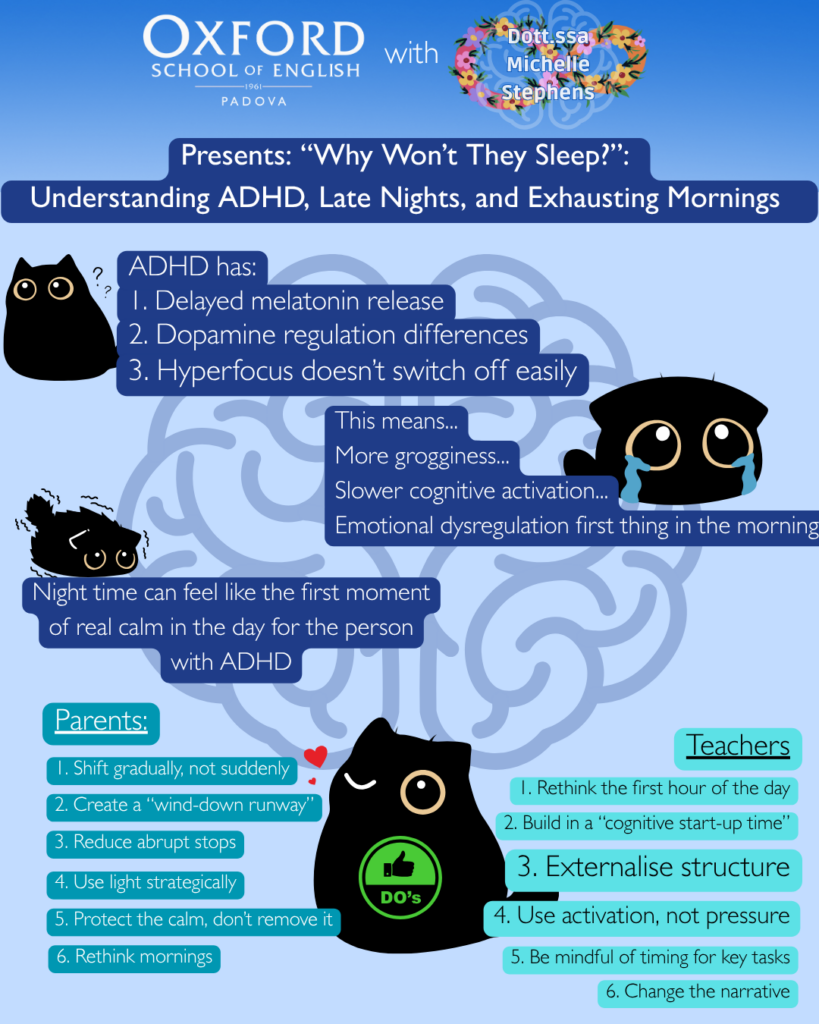
1. Delayed melatonin release
Melatonin (the hormone that signals sleep), tends to be released later in ADHD brains. So when you’re saying “time for bed,” their brain may not yet be getting the biological signal to sleep which causes a dissociation between what you expect them to do, and what their brain is telling them.
2. Dopamine regulation differences
ADHD is linked to differences in dopamine, a neurotransmitter involved in alertness and motivation. In the evening, when stimulation drops, the brain may actually seek activity — leading to a “second wind” at night.
3. Hyperfocus doesn’t switch off easily
If a child is engaged (gaming, reading, thinking), their brain doesn’t naturally downshift. Stopping feels abrupt and uncomfortable.
Why some ADHD brains actually feel better at night
More recent research is starting to shift how we understand ADHD and sleep.
Instead of just seeing it as a “sleep problem,” researchers are increasingly looking at ADHD as partly a circadian rhythm difference — meaning the brain is naturally wired to become more alert later in the day.
But here’s where it gets interesting:
At night:
- External demands drop (no school, fewer expectations)
- Sensory input is reduced
- The environment becomes more predictable
For an ADHD brain – which spends the whole day filtering, inhibiting, and trying to stay “on track” this can feel like the first moment of real calm.
There’s less:
- Task-switching
- Social pressure
- Cognitive overload
And more:
- Mental space
- Stable focus
- Internal regulation
Some emerging perspectives suggest that this is the moment where the brain finally reaches a more comfortable level of regulation.
So when a child suddenly becomes more talkative, more creative, or more “themselves” at night it’s not just resistance.
It may be the first time all day their brain feels good, and that’s why bedtime can feel like such a loss, and how it can become a battlefield.
Why mornings are so hard
Although it’s not always obvious, the reason is pretty logical – if a child falls asleep later, they’re often waking during a deeper part of their sleep cycle.
That means:
- More grogginess
- Slower cognitive activation
- Emotional dysregulation first thing in the morning
It’s not laziness or anything to do with brain type, it’s literally the timing of the sleep cycle and the stage that the brain finds itself in.
What actually helps? (Parents and Carers)
Instead of forcing earlier sleep, it’s more effective to work with the brain, not against it.
1. Shift gradually, not suddenly
Move bedtime earlier in small increments (10–15 minutes), rather than making a big jump.
2. Create a “wind-down runway”
ADHD brains don’t switch off – they transition.
Try:
- Low stimulation activities (not zero stimulation)
- Predictable routines
- Same sequence every night
3. Reduce abrupt stops
Instead of “turn it off now,” give countdowns:
- “10 minutes left”
- “5 minutes left”
This helps the brain disengage more smoothly.
4. Use light strategically
- Bright light in the morning → helps shift the body clock earlier
- Dim lights in the evening → signals the brain to slow down
5. Protect the calm, don’t remove it
If night-time is the only moment a child feels regulated, removing it completely can backfire.
Instead:
- Allow a short “calm window” before bed
- Then gently transition into sleep
- Keep the feeling, change the timing
6. Rethink mornings
If possible:
- Build in extra time
- Use gentle wake-ups (light, sound, gradual alarms)
- Avoid high-demand tasks immediately
What can teachers do to help?
If an ADHD child’s brain is naturally running on a later rhythm, early school hours are often happening at their lowest point of alertness.
So what looks like:
- lack of effort
- disengagement
- “not a morning person”
…is often a brain that quite literally isn’t fully “online” yet.
The goal isn’t to lower expectations but rather to “adjust the runway” so they can actually take off.
1. Rethink the first hour of the day
The first lesson is often the hardest. Now, you’re probably thinking “yeah, for me too”, but stick with me here!
Where possible:
- Avoid putting high-demand cognitive tasks first thing
- Start with:
- review work
- low-stakes activities
- guided tasks instead of independent ones
Think: warm-up, not performance.
2. Build in a “cognitive start-up time”
ADHD brains often need longer to get going.
You can support this by:
- Allowing a few minutes to settle before expecting output
- Giving clear, simple first steps instead of full task instructions
- Checking in briefly before expecting independent work
Small scaffolds here prevent complete shutdown later.
3. Externalise structure
In the morning especially, internal organisation is harder.
Helpful supports:
- Written instructions (not just verbal)
- Step-by-step task breakdowns (super important for any neurodivergent brain that struggles with executive function, as we spoke about here: https://oxfordschool.com/padova/how-neurodivergent-students-approach-tasks/)
- Visual schedules or checklists
This reduces the cognitive load when the brain is still “booting up.”
4. Use activation, not pressure
Telling a tired ADHD student to “focus” rarely works.
Instead, try:
- Movement (even small: standing, handing out papers)
- Quick interactive questions
- Pair or group starts before independent work
You’re aiming to activate the brain, not force it.
5. Be mindful of timing for key tasks
If possible:
- Schedule tests, complex writing, or heavy thinking tasks later in the morning
- Use earlier slots for:
- recall
- discussion
- guided practice
This aligns better with when their brain is actually ready.
6. Change the narrative
This one matters more than it seems.
Instead of:
“They’re lazy in the morning”
Shift to:
“Their brain starts later – how do I support that?”
Students pick up on this quickly, and it often changes how they see themselves.
A quick note on teenagers (ADHD and neurotypical)
It’s not just ADHD.
As children move into adolescence, their sleep patterns naturally shift. This change is famously found even in neurotypical teens.
During puberty, the brain delays the release of melatonin, this means that:
- Teens don’t feel sleepy until later
- Their natural wake time also shifts later
This is known as a delayed sleep phase, and it’s considered a normal part of development.
So when a teenager:
- struggles to fall asleep early
- finds mornings painful
- seems “slow” to start the day
…they’re not being difficult, honestly, it’s just that their biology has changed to accomodate their changing body and brain.
Why this matters for ADHD teens
ADHD already comes with a tendency toward a later body clock. As we mentioned before, throughout their lifespan ADHD people tend to be nightowls, finding solace in the early hours of the night. One can imagine that many poets and artists may have fallen into this category!
However, what we have happening in adolescence is that you often get a double effect:
- the typical teenage shift plus
- ADHD-related circadian differences
Which can mean:
- even later sleep onset
- even harder mornings
- more pronounced fatigue and dysregulation early in the day
What this means in practice
For teachers and parents, this is a useful reframe:
Morning struggles in teens (in general), as frustrating as they can be, aren’t a motivation issue, they’re a timing mismatch between biology and expectations.
And for ADHD teens, that mismatch is often just… bigger.
If mornings are hard for most teenagers, imagine how much harder they can be for a brain that’s already running on a different clock.
Final thoughts
An ADHD child who stays up late and struggles in the morning isn’t being difficult – they’re out of sync with a system that wasn’t designed for their brain.
And sometimes, they’re not avoiding sleep… They’re holding onto the only moment all day that feels calm.
When we stop treating sleep as a discipline issue and start treating it as a neurobiological pattern, we can respond with strategies that actually work – without taking away the parts of the day their brain genuinely needs.
Did this help?
Follow us for more as we launch our new inclusion programme aimed at increasing accessibility to education for neurotypical and neurodivergent students alike!
For more information on the programmes, workshops and coaching we offer please contact inclusione@oxfordschool.com or 049 656180
References (and reading!)
Coogan, A. N., & McGowan, N. M. (2017). A systematic review of circadian function, chronotype, and attention deficit hyperactivity disorder. Attention Deficit and Hyperactivity Disorders, 9(3), 129–147.
https://doi.org/10.1007/s12402-016-0214-5
Lunsford-Avery, J. R., Kollins, S. H., & Mitchell, J. T. (2018). Delayed circadian rhythm phase in adults with attention-deficit/hyperactivity disorder. Journal of Biological Rhythms, 33(4), 435–445.
https://www.ncbi.nlm.nih.gov/pmc/articles/PMC6487490/
Van der Heijden, K. B., Smits, M. G., Van Someren, E. J. W., Ridderinkhof, K. R., & Gunning, W. B. (2007). Effect of melatonin on sleep, behavior, and cognition in ADHD and chronic sleep-onset insomnia. Journal of the American Academy of Child & Adolescent Psychiatry, 46(2), 233–241.
https://doi.org/10.1097/01.chi.0000246055.76167.0d
Van Geijlswijk, I. M., Korzilius, H. P. L. M., & Smits, M. G. (2010). The use of exogenous melatonin in delayed sleep phase disorder: A meta-analysis. Sleep, 33(12), 1605–1614.
https://www.ncbi.nlm.nih.gov/pmc/articles/PMC2982730/
Luu, B., et al. (2025). Circadian rhythm disruption and attention deficit hyperactivity disorder: An emerging perspective. Frontiers in Psychiatry.
https://www.frontiersin.org/articles/10.3389/fpsyt.2025.1697900/full
Nair, S., et al. (2025). Sleep and circadian disruption in ADHD: Implications for functioning and mental health. BMJ Mental Health.
https://mentalhealth.bmj.com/content/28/1/e301625
Crowley, S. J., Acebo, C., & Carskadon, M. A. (2007). Sleep, circadian rhythms, and delayed phase in adolescence. Sleep Medicine, 8(6), 602–612.
https://doi.org/10.1016/j.sleep.2006.12.002



Lascia un commento