
When It’s Not Depression: Understanding Hyperfocus, Hypofocus, and ADHD Burnout

My name is Michelle and I’m a neuropsychologist (LM51), educational coach and qualified teacher (PGCE) with nearly 20 years of experience in the field. I’m working with Oxford School of Padova to bring inclusion topics into the field of English teaching and education in general. This article is part of a series in which we’re exploring different neurological and neuropsychological concepts which aim to not only improve accessibility to education, but also give YOU – the parent or teacher – concrete ways in which you can achieve this with your students.
When “I Can’t Be Bothered To Do Anything” Isn’t Depression
One of the most misunderstood parts of ADHD and neurodivergence in general is the idea of “focus.”
Many people assume ADHD simply means not being able to pay attention, but the reality is not quite as clear-cut, which can lead to a lot of pop-psychology and confused terms.
In educational settings and even at home, we often see students who swing between two extremes:
- becoming completely absorbed in one activity for hours to the extent that they don’t want to even get up to use the bathroom, eat or drink AND….
- struggling to engage with anything at all.
From the outside, this can sometimes look like laziness, lack of motivation, or even depression and it’s easy to think that that’s the case, but while depression can absolutely overlap (it’s often comorbid with ADHD and autism), and we’ve all had moments of wanting to do nothing and/or simply lacking any sort of motivation (think Monday morning before your first coffee of the day!) they are not always the same thing.
What is Hyperfocus?
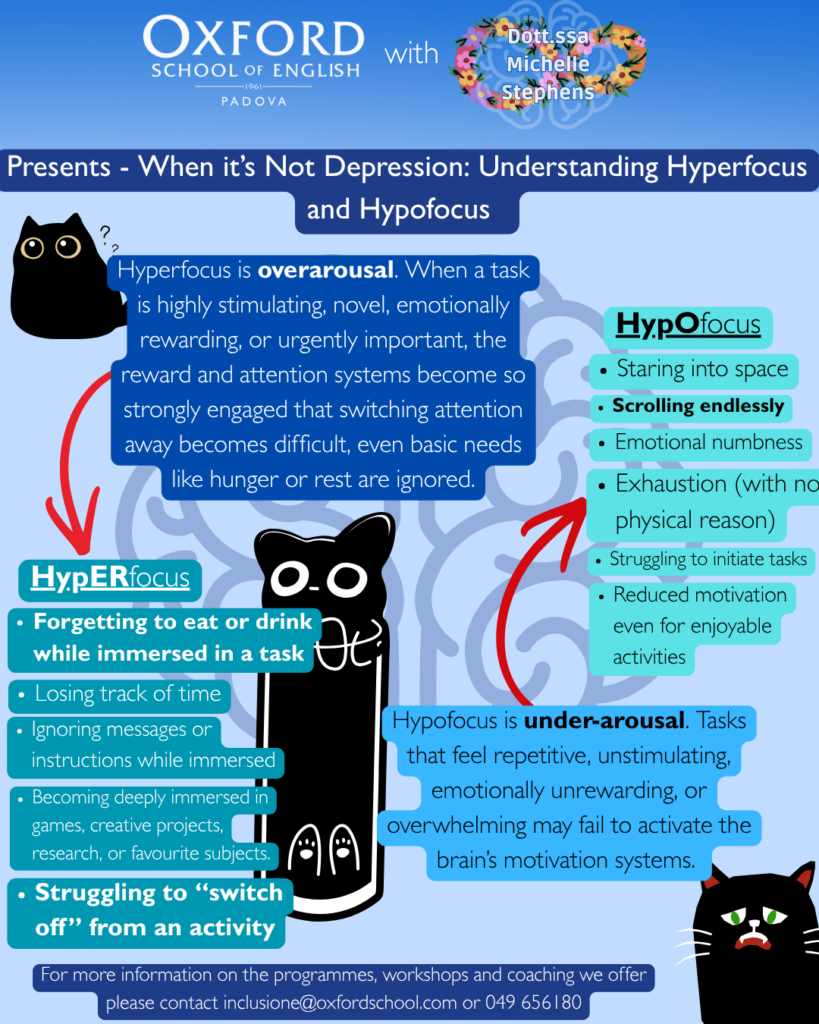
Hyperfocus is, for all intents and purposes the poster-child for ADHD, and is a frequently mentioned state in reference to neurodivergence. It’s a state of intense concentration where the brain becomes so immersed in a task, interest, or activity so strongly that everything else fails to register on any level.

A student in hyperfocus might:
- forget to eat or drink,
- lose track of time,
- ignore messages or instructions,
- struggle to “switch off” from an activity,
- become deeply immersed in games, creative projects, research, or favourite subjects.
Importantly, hyperfocus is not “good concentration” in the traditional sense, you might get a week’s worth of work out of your student in this state and it might feel good to see them so concentrated on a single thing, but it can have negative physical outcomes. This state is often less about control, the person isn’t CHOOSING to become hyperfocussed, but more about the brain becoming neurologically “stuck” on something highly stimulating or rewarding.
What is Hypofocus?

Hypofocus is almost the opposite experience and is hugely under-represented in our pop-psychology culture of neurodivergence knowledge.
Instead of feeling intensely engaged, the brain feels under-stimulated, flat, foggy, or disconnected. Tasks that normally feel manageable can suddenly feel overwhelming or impossible to start. This can become chronic enough that it starts to look like depression, but this state isn’t controlled by the same mechanisms as in depression.
Hypofocus might look like:
- staring into space,
- scrolling endlessly,
- emotional numbness,
- exhaustion,
- struggling to initiate tasks,
- reduced motivation even for enjoyable activities.
For many neurodivergent people, periods of prolonged stress, masking, overwhelm, continuous understimulation or burnout can push the nervous system into this hypo-aroused state where the brain isn’t receiving enough stimulation for tasks to appear important enough for the brain to care about.
Again, this isn’t something that the individual has control over and we might see it most commonly where we have a very bright and able student who is working at a level much below their capacity. Their tasks stop giving their brain any sort of reward, and unlike a neurotypical student who can usually push through this to a degree, the neurodivergent brain is much more sensitive to lack of stimulation to the point that it can be PHYSICALLY uncomfortable and limiting.
At this point I would like to impress upon the reader that this state is NOT a choice. It’s not something they can “snap out of” and should be treated with consideration. It feels no more possible for a hypo-stimulated brain to suddenly find its motivation again than it would be for someone to get up and start walking on a broken leg – physically possible, but with every instinct telling you not to.
What About Burnout?
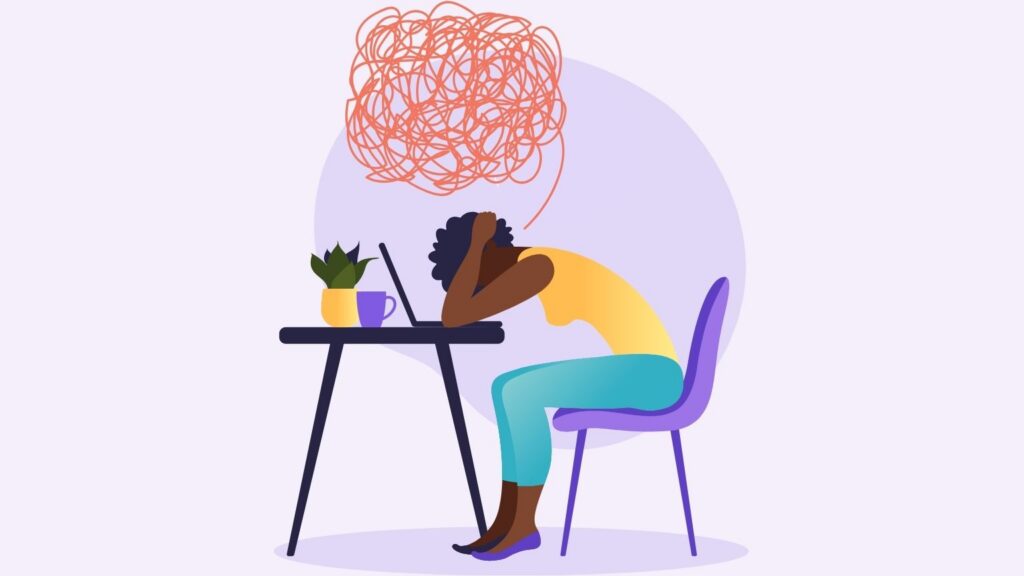
It’s also important to recognise that many neurodivergent individuals will experience intense periods of ADHD or autistic burnout. While this has become something of a buzz-word in recent years, neurodivergent burnout is slightly different to neurotypical stress induced burnout. Neurotypical burnout is usually linked to prolonged workload, emotional strain, or lack of rest, and often improves once stress is reduced and recovery time is allowed. Instead, individuals with neurodivergent brains spend a large amount of energy and cognitive resource to appear “normal” and fit in. Due to years of micro-aggressions and tens of times more negative feedback in their formative years they may also tend to work 1000% on something, until they are no longer physically capable of doing so. Often feeling as though they have “something to prove”.
As a result, ADHD or autistic burnout may involve:
- increased sensory sensitivity,
- loss of previously manageable skills,
- emotional shutdown,
- difficulty speaking or communicating,
- severe executive dysfunction,
- memory and concentration problems,
- heightened emotional reactivity,
- or periods of hypoarousal where the brain feels foggy, disconnected, or unable to engage.
Additionally, difficulties with social nuance can lead to genuine misinterpretation of every day phrases such as “give your 100%”. Whereas most neuroptyical people understand this is a sliding scale which includes leaving room for “every day life” autistic and ADHD people may not have picked up on that, and think that they must give EVERYTHING to a project.
Unlike ordinary tiredness, burnout is a state of physical, emotional, and cognitive exhaustion caused by prolonged stress, masking, overwhelm, or constantly working beyond the brain’s natural capacity. During burnout, people may appear withdrawn, unmotivated, emotionally flat, or unable to complete everyday tasks and this state can sometimes resemble depression from the outside. However, the underlying cause is often nervous system overload rather than a loss of interest in life itself.
So… Is It Depression?
Sometimes yes, but not always.
Depression typically involves a persistent low mood and reduced ability to experience pleasure across many areas of life, which typically isn’t the case with hypofocus – the individual might be truly uninterested in completing most tasks, but they will be able to enjoy dopamine-rich and rewarding tasks (and this is, in fact the key to helping them break away from a hypofocussed state). You can find out more about depression here: https://www.mind.org.uk/information-support/types-of-mental-health-problems/depression/about-depression/
Hypofocus and neurodivergent burnout are often more closely linked to nervous system overload, cognitive exhaustion, and chronic stress and/or a chronic lack of stimulation.
One key difference is that many ADHD or autistic individuals still want to engage. They may still feel interest, excitement, or curiosity internally but instead struggle to access the energy, activation, or executive functioning needed to act on it which is where they can get blocked into this state.
Interestingly, hyperfocus can still appear during burnout or low mood, especially when an activity provides enough stimulation to temporarily “wake up” the brain and catch its attention.
Why This Matters in Education
When educators understand the difference between disengagement, burnout, and depression, it changes the support we provide and the way we approach the situation.
A student who appears “lazy” may actually be cognitively overloaded.
A student who seems “obsessed” with one topic may not be choosing to ignore everything else.
And a student who cannot start work may not need more pressure, but instead they may need regulation, structure, recovery, or more accessible support strategies.
Understanding these patterns allows us to move away from blame and toward supportive, neuro-informed approaches that help students engage more effectively with learning and with themselves.
How Can Teachers Help?
Here we want to focus on supportive strategies, as they tend to work far better than punishment or increased pressure.
For students stuck in hyperfocus, gentle transitions can help. Things like:
- Clear warnings before task-switching,
- Visual timers (pomodoro method or smart board widgets work well here)
- Structured routines,
- Breaking transitions into smaller steps can reduce distress and help the brain disengage more gradually from the activity.
For students experiencing hypofocus, increasing accessibility and engagement is often more effective than simply demanding more effort. This might include:
- Reducing overwhelm,
- Breaking work into smaller achievable tasks,
- Incorporating movement or novelty, offering choices,
- Using interest-based learning where possible, and
- Providing regular positive feedback to activate motivation systems.
Did this help?
Follow us for more as we launch our new inclusion programme aimed at increasing accessibility to education for neurotypical and neurodivergent students alike!
For more information on the programmes, workshops and coaching we offer please contact inclusione@oxfordschool.com or 049 656180
References (and reading!)
Ayers-Glassey, S., & Smilek, D. (2023). The relations between hyperfocus and similar attentional states, adult ADHD symptoms, and affective dysfunction. Current Psychology, 42(12), 11254–11266. https://doi.org/10.1007/s12144-023-05235-3
Barkley, R. A., & Murphy, K. R. (2010). Deficient emotional self-regulation: A core component of attention-deficit/hyperactivity disorder. Guilford Press.
Dupuis, A., et al. (2022). Hyperfocus or flow? Attentional strengths in autism spectrum disorder. Frontiers in Psychiatry, 13. https://doi.org/10.3389/fpsyt.2022.889102
Mind. (n.d.). About depression. https://www.mind.org.uk/information-support/types-of-mental-health-problems/depression/about-depression/
National Health Service. (n.d.). Depression in adults. https://www.nhs.uk/mental-health/conditions/depression-in-adults/overview/
Neff, D. (n.d.). Autistic burnout: It’s not depression or occupational burnout. Neurodivergent Insights. https://neurodivergentinsights.com/autism-and-burnout/
Raymaker, D. M., Teo, A. R., Steckler, N. A., et al. (2020). “Having all of your internal resources exhausted beyond measure and being left with no clean-up crew”: Defining autistic burnout. Autism in Adulthood, 2(2), 132–143. https://doi.org/10.1089/aut.2019.0079



Lascia un commento