
When Neurodivergent Children Become Neurodivergent Adults
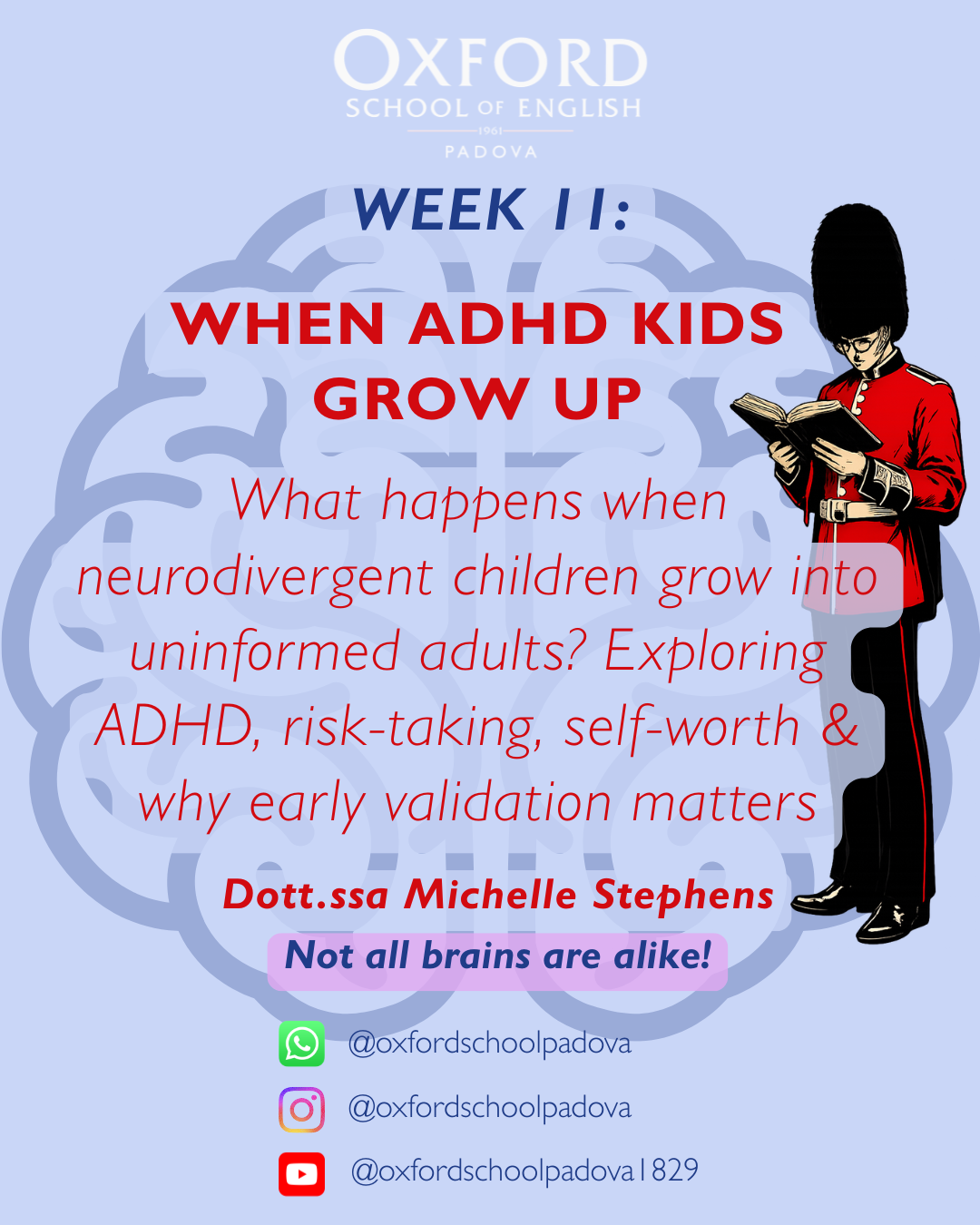

My name is Michelle and I’m a neuropsychologist (LM51), educational coach and qualified teacher (PGCE) with nearly 20 years of experience in the field. I’m working with Oxford School of Padova to bring inclusion topics into the field of English teaching and education in general. This article is part of a series in which we’re exploring different neurological and neuropsychological concepts which aim to not only improve accessibility to education, but also give YOU – the parent or teacher – concrete ways in which you can achieve this with your students.
Happy mid-week readers. Today’s piece is more of an opinion piece, as this week I’ve had a lot of conversations with people around neurodivergence in schools and how we’re dealing with it. So many people are aware of how many children are “appearing” with diagnoses of ADHD and autism, how short the general attention span in Gen Alpha children is, and the struggles we, as teachers, have in recruiting parents into understanding how important it is to support their neurodivergent child so that their education doesn’t suffer.
But today I’d like to go deeper, to impress upon you all the importance of supporting children when they’re children. Because ADHD and autistic children will – sparing any tragedy – become ADHD and autistic adults. What then?
“How Can She Keep Making The Same Mistake?”
Let me tell you a story.
A friend of someone I know was talking to me about how reckless some people can be. This person, let’s call them Marco for the purposes of this story, had started recounting a story about a friend of his when I’d said that I don’t believe that stupidity is the leading cause of making bad decisions.
Beatrice (also not her name) had gone through the process of terminating a pregnancy for the third time in a year, from a third father that year. This last being deemed almost too risky to do safely. Putting aside ethical and moral debates about this issue, which we won’t get into here, Marco had explained how shocked he was at how “stupid” this person could be.
He was smiling as he told me that she herself had described her behaviour as “stupid”, and that she didn’t know how it kept happening.
“How can she keep making the same mistake?” he’d asked.
“Isn’t it bad enough that she’s always drunk or on drugs and always needs to borrow money?” he’d lamented to us.
Beatrice Isn’t Stupid
Beatrice has a long-term history of drug and alcohol abuse. She’s sweet, smart, and witty, but she forgets things, gets distracted easily, has difficulty maintaining focus, talks excessively, frequently interrupts other people, and can’t seem to sit still.
Her interests and hobbies change regularly as she loses interest in one thing and gets hooked on another.
Beatrice is likely one of (too) many women with undiagnosed ADHD.
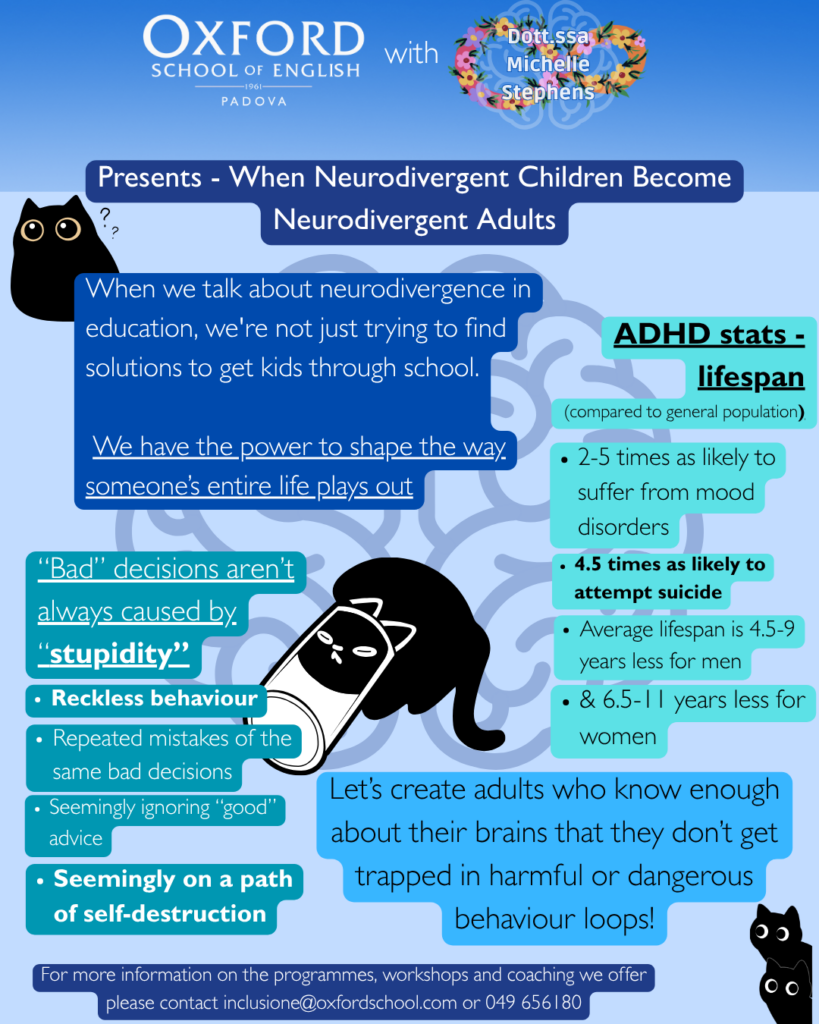
In adults, people with ADHD are TWICE as likely to have substance abuse problems as people from the general population. They’re 2-5 times as likely to suffer from comorbid (co-occurring) mood disorders; (on average) 4.5 times as likely to attempt suicide and 3.5-5 times more likely to die from suicide.
They’re more likely to end up in prison, in abusive relationships, and to be unemployed. People with ADHD are 40-50% more likely to end up in traffic accidents or with chronic health conditions. And the average lifespan is 4.5-9 years (for men) and 6.5-11 years (for women) less than the general population.
“I’m Stupid”
If you, as a child, are given advice for a brain that’s nothing like your own, and punished more frequently for not being able to do what your classmates do – or in the same way – you’re very likely to end up with self-deprecating beliefs, which, in turn, lead to the fulfilment of self-fulfilling prophecies.
I’m stupid. I can’t do anything. I’m a weirdo.
But by believing you’re stupid, you’re also not likely to then search for the reasons behind your risky behaviour. Sleeping around, drinking too much, taking drugs.
If you believe you’re stupid or worthless, then that becomes the only reason, leading to loops like the one Beatrice found herself in.
What Happens Next?
When autistic and ADHD children become adults, if they’ve never been validated as they are, if they’ve never had the benefit of the doubt, or learnt strategies that helped them cope with their different brain, statistically, they’re going to become adults with severe issues.
Beatrice isn’t stupid, she has just never had adequate support for her brain.
We’re not just trying to find solutions to get kids through school. We, as teachers, are so much more important than that. We have the power to shape the entire life course of a person.
So when we talk about this, and when we implement it in class, we’re letting them know that their brain is just as valid as any other brain, and that sometimes they’re going to need to be creative with the blocks that come with that in modern society.
We’re trying to set them up so that they become adults who are well enough informed about themselves that they don’t end up in dangerous, harmful, or “reckless” spirals.
Did this help?
Follow us for more as we launch our new inclusion programme aimed at increasing accessibility to education for neurotypical and neurodivergent students alike!
For more information on the programmes, workshops and coaching we offer please contact inclusione@oxfordschool.com or 049 656180
References (and reading!)
American Psychiatric Association. (2022). Diagnostic and statistical manual of mental disorders (5th ed., text rev.; DSM–5–TR). American Psychiatric Publishing.
Barkley, R. A., & Fischer, M. (2019). The unique contribution of emotional impulsiveness to impairment in major life activities in hyperactive children as adults. Journal of the American Academy of Child & Adolescent Psychiatry, 49(5), 503–513. https://doi.org/10.1016/j.jaac.2010.01.019
Faraone, S. V., Banaschewski, T., Coghill, D., Zheng, Y., Biederman, J., Bellgrove, M. A., Newcorn, J. H., Gignac, M., Al Saud, N. M., Manor, I., Rohde, L. A., Yang, L., Cortese, S., Almagor, D., Stein, M. A., Albatti, T. H., Aljoudi, H. F., Alqahtani, M. M. J., Asherson, P., … Wang, Y. (2021). The world federation of ADHD international consensus statement: 208 evidence-based conclusions about the disorder. Neuroscience & Biobehavioral Reviews, 128, 789–818. https://doi.org/10.1016/j.neubiorev.2021.01.022
Kooij, J. J. S., Bijlenga, D., Salerno, L., Jaeschke, R., Bitter, I., Balázs, J., Thome, J., Dom, G., Kasper, S., Nunes Filipe, C., Stes, S., Mohr, P., Leppämäki, S., Casas, M., Bobes, J., Mccarthy, J. M., Richarte, V., Kjems Philipsen, A., Pehlivanidis, A., … Asherson, P. (2019). Updated European Consensus Statement on diagnosis and treatment of adult ADHD. European Psychiatry, 56, 14–34. https://doi.org/10.1016/j.eurpsy.2018.11.001
Nigg, J. T. (2013). Attention-deficit/hyperactivity disorder and adverse health outcomes. Clinical Psychology Review, 33(2), 215–228. https://doi.org/10.1016/j.cpr.2012.11.005
Ramsay, J. R., & Rostain, A. L. (2015). Adult ADHD: Research, diagnosis, and treatment. Routledge.
Russell, A. E., Ford, T., Williams, R., & Russell, G. (2016). The association between socioeconomic disadvantage and attention deficit/hyperactivity disorder (ADHD): A systematic review. Child Psychiatry & Human Development, 47(3), 440–458. https://doi.org/10.1007/s10578-015-0578-3
Young, S., Moss, D., Sedgwick, O., Fridman, M., & Hodgkins, P. (2015). A meta-analysis of the prevalence of attention deficit hyperactivity disorder in incarcerated populations. Psychological Medicine, 45(2), 247–258. https://doi.org/10.1017/S0033291714000762



Lascia un commento