
Training Executive Functioning in the Classroom With One Simple Rule-Switch Game

My name is Michelle and I’m a neuropsychologist (LM51), educational coach and qualified teacher (PGCE) with nearly 20 years of experience in the field. I’m working with Oxford School of Padova to bring inclusion topics into the field of English teaching and education in general. This article is part of a series in which we’re exploring different neurological and neuropsychological concepts which aim to not only improve accessibility to education, but also give YOU – the parent or teacher – concrete ways in which you can achieve this with your students.
Executive functioning skills are some of the most important, and certainly most overlooked, skills in learning and education. They help students start tasks, shift attention, regulate impulses, hold instructions in mind, and adapt when situations change.
For many students, especially ADHD and neurodivergent learners, the difficult part isn’t understanding a task… it’s when they need to adjust a pattern their brain has already settled into.
That’s where simple “rule-switch” activities can help.
These short exercises train students to:
- notice changing instructions
- stop automatic responses
- adapt quickly and calmly
- monitor their own mistakes
And the best part? They only take a few minutes and require almost no preparation… and even less if you use the resources I’ve prepared and uploaded for you at the end of this post!
The Shape Switch Game
This version focuses primarily on cognitive flexibility. This is the ability to adapt when rules change (first mentioned in this blog post “Funzioni Cognitive: Cosa Sono è Perche Ci Interessano?”).
Step 1: Create/assign the task
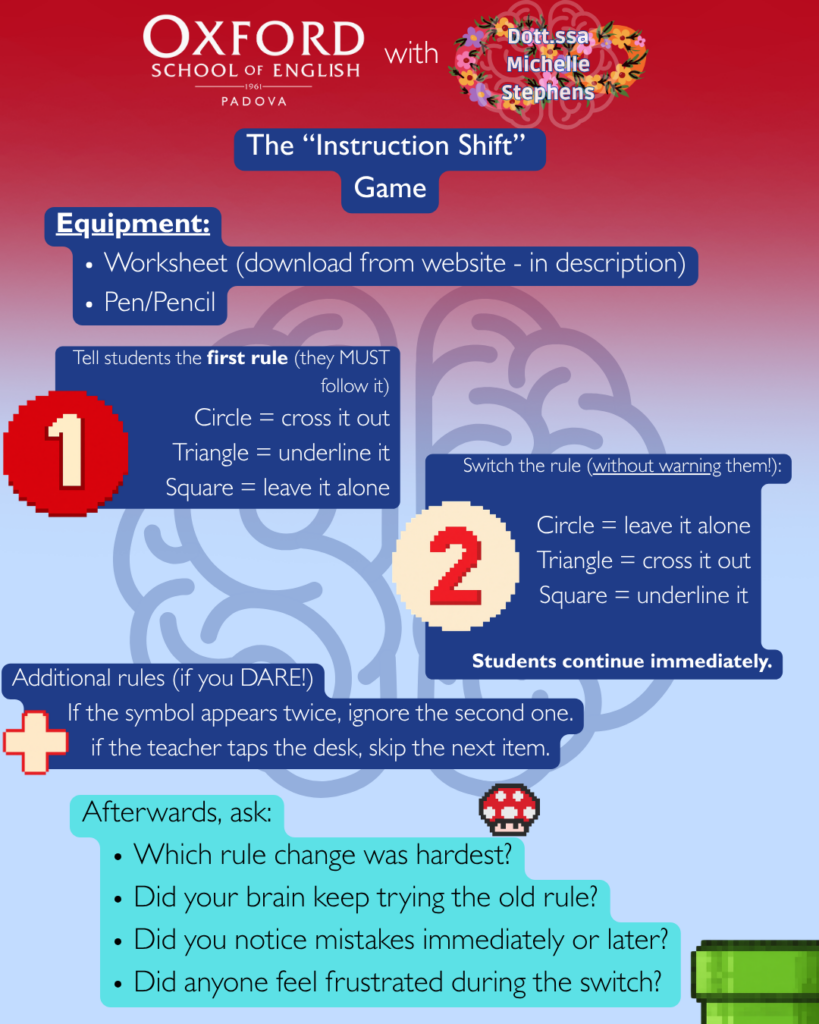
Give students a row or worksheet filled with shapes:
○ △ □ ○ □ △ ○ △ □
Step 2: Set the rules
Assign each shape an action:
- Circle = underline
- Triangle = cross out
- Square = leave alone
Allow students to work for around 30–60 seconds depending on the class’s ability and how awake they are!
Step 3: (The fun bit) Switch the rules
Without warning, abruptly change the instructions:
- Circle = leave alone
- Triangle = underline
- Square = cross out
Students must now:
- stop using the old rule
- hold the new rules in mind
- adapt quickly
You can switch the rules as often as you like, but try to give them at least 20 seconds to adjust to one rule before changing it (or implementing new rules)
Why does this work?
Well, the brain – be it neurotypical or neurodivergent – naturally looks for efficiency and patterns. The human brain is designed to make life as easy for us as possible. In addition to this, your ADHD/autisic students can often have increased pattern recognition skills… once students become comfortable with a rule, their responses will become increasingly automatic.
Switching the rules forces students to interrupt that automatic behaviour and update their thinking in real time, causing the brain to adjust to new rules quickly and hold that new information in working memory.
That process trains:
- cognitive flexibility
- inhibitory control
- working memory
- self-monitoring
Extra rules – if you dare!
On top of the exisiting rules, if you think your students are up to the challenge, you can gradually increase the executive functioning demand by adding extra conditions such as:
- “If a shape appears twice in a row, skip the second one.”
- “Every 5th shape must be circled instead.”
- “If I clap, reverse the rules.”
The goal is not perfection or speed, you’re not training them to recognise patterns or cross out shapes, instead you’re aim is to help students practise the soft skills required to interrupt behaviour and adapt to new rules and new conditions when their brain wants to follow an old pattern.
Disclaimer: If you’re working with autistic or ADHD children who have particular difficulty with change, please play this game very slowly and only when they’re up to doing so!
English Lesson Version
This activity can also be embedded directly into your English lesson!
For example:
- Noun = underline
- Verb = cross out
- Adjective = leave alone
Then switch the rules after a short period of time (remember, at least 20-30 seconds).
Some additional rules which can increase the difficulty are:
- “Ignore words beginning with vowels.”
- “If the word is plural, use the old rule.”
- “If two adjectives appear together, skip the second one.”
This will allow you to not only train your students’ executive functioning skills, but it will also allow you to simultaneously reinforce grammar, vocabulary, and language awareness.
Why you should try this activity…
This type of exercise is not only:
- short
- low-prep
- easy to differentiate
- adaptable across subjects
- engaging without feeling childish
It also normalises the experience of cognitive struggle. It may not be obvious at the start, but you should see at some point that every student’s brain tries to continue the old rule. This in turn can become a valuable opportunity for you and your class to discuss flexibility, attention, and learning strategies in a non-judgemental way.
The science behind it all
While this activity might seem simple, even a bit of a waste of time, they actually come from a solid psychological reasoning built from studying years of research, which I’ll explain now.
Cognitive Flexibility
Underneath everything, this activity is built to train something we call “cognitive flexibility“. This is the brain’s ability to adapt when rules, expectations, or situations change. This skill is an essential part of executive functioning, and it’s something that plays a major role in classroom learning, social etiquiette and behaviour. Students use cognitive flexibility when they move between subjects, adapt to new instructions, recover after mistakes, have plans change or other people change their mind, or it helps them to change strategies when something is not working.
The very reason the game works is because the brain naturally seeks efficiency. Once students have followed the same rule for a short period of time, their responses begin to become automatic. When the teacher suddenly changes the rule, students must not only interrupt that automatic response, but they also need to suppress the old instructions, and apply a new one instead while keeping this all in their memory AND paying attention to the teacher.
That process mirrors the same mechanisms explored in classic neuropsychological tasks used to measure executive functioning, such as the Wisconsin Card Sorting Test. In this task, participants must identify changing sorting rules and adapt when those rules shift unexpectedly. One of the key difficulties measured is something called perseveration. This is when the brain continues to follow an old rule even after it no longer applies. This is exactly what we see when students make “mistakes” during this game – their brain continues trying to apply the previous instruction.
Inhibitory Control
The activity also draws heavily on inhibitory control, this is another core executive functioning skill. Inhibitory control is the ability to stop automatic or impulsive responses, and something that can be very challenging for certain groups of students. When students accidentally underline the wrong shape or continue following the previous rule, they’re finding out how difficult inhibition can be in real time – even if it’s something that is already in seen in their behavioural profile. The brain must essentially “hit the brakes” on a response pathway that has already started becoming automatic.
This is one reason “do nothing” rules can be particularly powerful. Oddly, asking students not to respond often requires more executive control than asking them to perform an action. This is well documented throughout pyschology, and similar mechanisms have been studied extensively in well-known cognitive tasks such as the Stroop effect and Go/No-Go tasks, both of which examine how effectively the brain can suppress competing or automatic responses.
Working memory
As additional rules are introduced, the activity also begins engaging working memory. Students may need to remember multiple conditions at once, track counting rules, or hold temporary exceptions in mind while continuing the task. Working memory plays a major role in everyday classroom functioning, including following instructions, reading comprehension, note-taking, and completing multi-step tasks.
Researchers such as Alan Baddeley and Adele Diamond have thoroughly highlighted through the years how closely connected these executive functioning systems are to learning, self-regulation, and academic performance.
Activities like this may be particularly useful for students with ADHD or other neurodivergent profiles, as research frequently identifies that these populations of students can have difficulties with task switching, inhibitory control, sustained attention, and working memory. Most importantly though, even if these students experience challenges with these skills, it doesn’t mean these skills can’t be improved. The good news is, is that executive functioning skills are highly influenced by practice, environment, and scaffolding.
Short, low-stakes activities like this allow students to practise:
- adapting to change
- catching automatic responses
- recovering after mistakes
- monitoring their own thinking
without the emotional pressure that often accompanies academic assessment.
Perhaps most importantly…
these exercises help normalise the experience of cognitive struggle. It happens to everyone, and at some point most people these days have wondered whether they fit the criteria for ADHD or autism, as our brains can experience glitches in these processes regardless of how neurotypical or neurodivergent they might be. The question is always of degree and impact. So here, it can be a taste of how it might feel for other students. Every student’s brain tries to continue the old rule at some point. That moment of “oops, I brain farted” becomes an opportunity for reflection rather than failure, and that shift in mindset can be incredibly valuable in the classroom.
Did this help?
Follow us for more as we launch our new inclusion programme aimed at increasing accessibility to education for neurotypical and neurodivergent students alike!
For more information on the programmes, workshops and coaching we offer please contact inclusione@oxfordschool.com or 049 656180
References (and reading!)
Diamond, A. (2013). Executive functions. Annual Review of Psychology, 64, 135–168. https://doi.org/10.1146/annurev-psych-113011-143750
Miyake, A., Friedman, N. P., Emerson, M. J., Witzki, A. H., Howerter, A., & Wager, T. D. (2000). The unity and diversity of executive functions and their contributions to complex “frontal lobe” tasks: A latent variable analysis. Cognitive Psychology, 41(1), 49–100. https://doi.org/10.1006/cogp.1999.0734
Baddeley, A. D., & Hitch, G. J. (1974). Working memory. In G. H. Bower (Ed.), Psychology of learning and motivation (Vol. 8, pp. 47–89). Academic Press. https://doi.org/10.1016/S0079-7421(08)60452-1
Stroop, J. R. (1935). Studies of interference in serial verbal reactions. Journal of Experimental Psychology, 18(6), 643–662. https://doi.org/10.1037/h0054651
Grant, D. A., & Berg, E. A. (1948). A behavioral analysis of degree of reinforcement and ease of shifting to new responses in a Weigl-type card-sorting problem. Journal of Experimental Psychology, 38(4), 404–411. https://doi.org/10.1037/h0059831
Barkley, R. A. (2012). Executive functions: What they are, how they work, and why they evolved. Guilford Press.
Diamond, A., & Lee, K. (2011). Interventions shown to aid executive function development in children 4 to 12 years old. Science, 333(6045), 959–964. https://doi.org/10.1126/science.1204529
Willcutt, E. G., Doyle, A. E., Nigg, J. T., Faraone, S. V., & Pennington, B. F. (2005). Validity of the executive function theory of attention-deficit/hyperactivity disorder: A meta-analytic review. Biological Psychiatry, 57(11), 1336–1346. https://doi.org/10.1016/j.biopsych.2005.02.006



Lascia un commento